The Central Power Source:
Your xRM/CRM as a “Single Source of Truth”
In today's complex business world, the biggest obstacle to efficiency is often a lack of data consistency. Data on customers, suppliers, authorities, and all relevant business partners is scattered across isolated applications. This leads to extra work due to manual data transfer, high IT integration costs, errors, and unnecessary risk. Our solution: xRM/CRM as a single source of truth (SSOT): Maintain once, use everywhere.
The xRM/CRM is the heart of your entire process chain and ensures that every subsequent step, every function builds on the same reliable information.

xRM/CRM
The immediate advantages of centralized data storage
1. Guaranteed data quality in all functions
The xRM/CRM block bundles all relevant master data (addresses, contact persons, tax numbers, VAT numbers) and eliminates redundant data records. For example, if a customer's address changes, this is corrected once and is immediately available for all functions. This is the basis for smooth communication and protects you from compliance risks due to outdated or incorrect partner data.
2. Seamless synergy with your business processes
The true strength of SSOT unfolds in its integration with your other function blocks:
Billing security:
The management of sales, costs, invoice corrections (credit notes), and entertainment receipts directly accesses the verified data from xRM/CRM. Correct addresses and tax codes are immediately available, making it easier to create error-free invoices.
GoBD compliance:
By linking business partner and business transaction data (from XRM/CRM) with document management, you get a business transaction file right where you expect it—in business transaction management.
Our Process
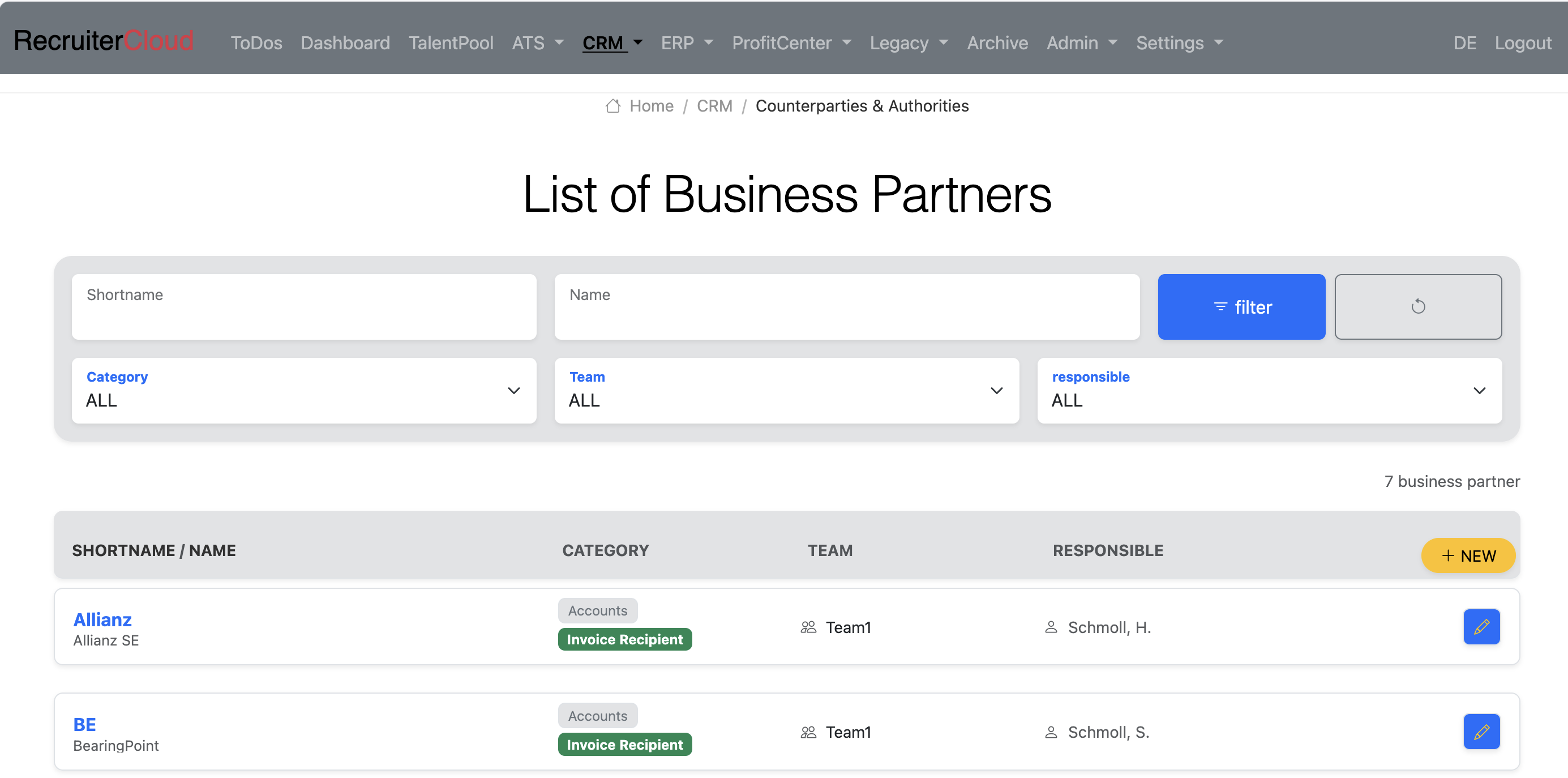
Recording the Business Partners
In the first step, the business partner's data is recorded and assigned to a category such as customer, supplier, or public authority. This categorization serves to keep the selection clear in later work steps—when recording sales, for example, only customers are offered for selection. To avoid redundancies, subsidiaries are not created as independent business partners, but are simply listed as additional addresses for the respective business partner.
Recording the Addresses
To avoid redundancy and multiple entries, addresses are not stored with contacts but as a separate category of information. If a business partner moves, the address is only changed in one place—it is then automatically updated for all associated contacts.
Recording the Contacts
When entering contact details, you first select one of the previously entered addresses. Then you enter the name and contact details and assign a category, which is used to form homogeneous contact groups for targeted marketing mailings.